

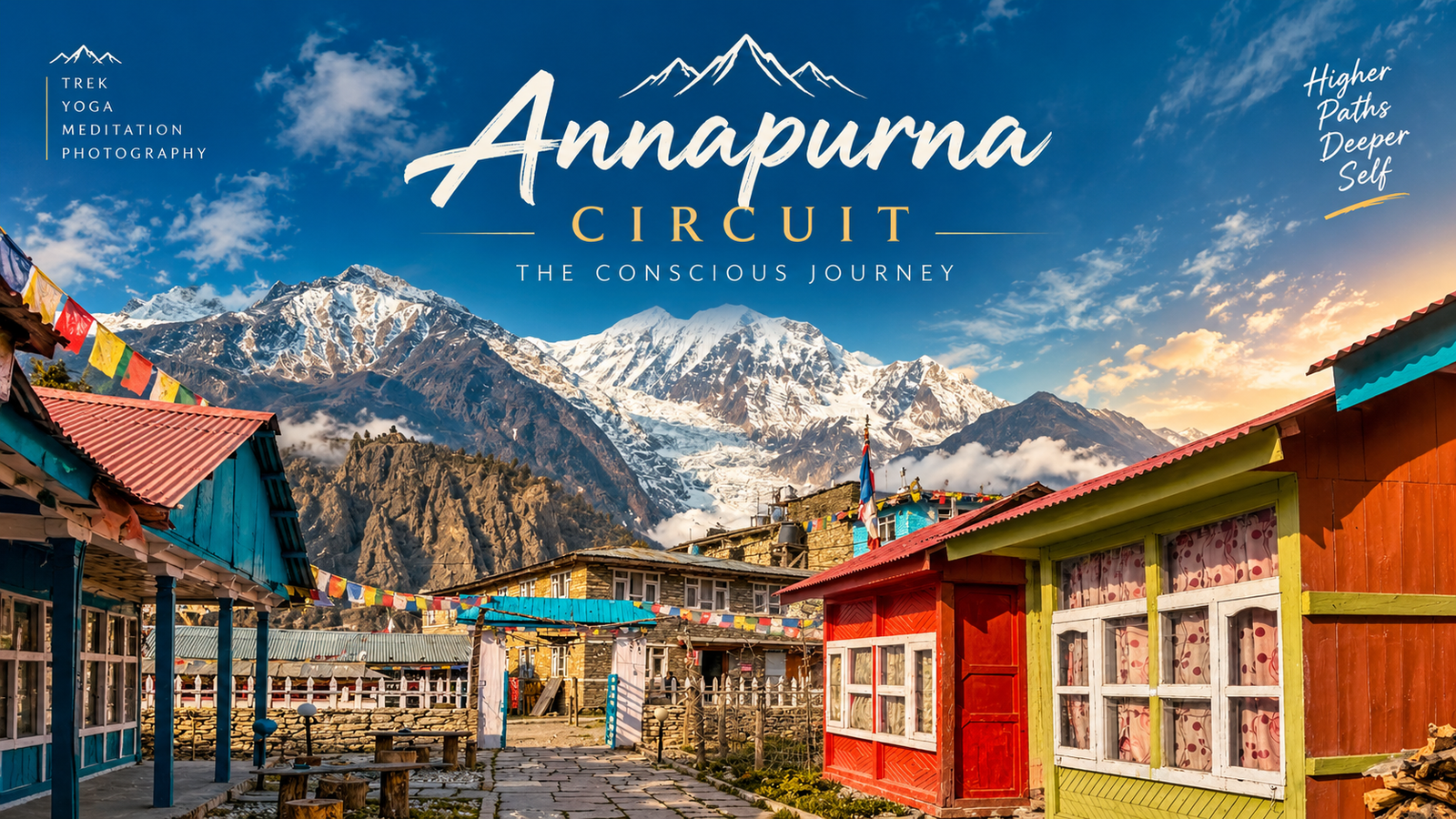
Annapurna Circuit with Migrated Monks
A 11-day conscious journey around the Annapurna Circuit, through Tilicho Lake and over Thorong La. We do not walk to conquer the mountains. We walk to notice them, and ourselves.
5,416 m
More than a trek
The Annapurna Circuit is a journey through changing landscapes, cultures, altitude, silence, and ultimately, yourself.
With Migrated Monks, we want to experience the Circuit not as a destination to complete, but as a journey to slow down, observe, connect, and feel.
Along the way we create space for breath awareness, mindful walking, gentle yoga, and quiet moments. These are not separate from the trek. They are how we experience the mountains more deeply.
Trek at a glance
A journey within the journey
Eight reasons this trek is different.
Walk among giants
Views of Annapurna, Dhaulagiri, Manaslu and Machapuchare. The land changes from green valleys to rock, ice and snow.
The Himalaya in winter
In mid-December the mountains are quieter and the air is sharper. Winter asks us to move with more awareness and respect.
Tilicho Lake
One of the highest lakes in the world, at about 4,900 m. The way is hard, and that is part of what makes it mean something.
Cross Thorong La
At 5,416 m, this is the high moment of the trek. It is about patience, breath, and taking one step at a time.
Himalayan culture
Monasteries, prayer flags, temples, local homes and small teahouses. We pause, listen and meet the people of the region.
Breath, yoga, silence
Gentle breath awareness, mindful walking, short yoga and quiet time, woven into every day. Kept easy and safe at altitude.
Nights in mountain villages
Simple homestays, warm meals, good talk, and sometimes only silence beside a fire. These are often the best memories.
A living ecosystem
From forests and rivers to alpine desert. The Annapurna Conservation Area is home to rich plants, birds and wildlife.
Your itinerary
Choose how you want to travel. The trek days are the same. The Delhi option adds the journey from and back to Delhi.
Day 017 DEC Delhi to Sonauli border, then towards Pokhara Travel dayMorning pickup
- Morning pickup in Delhi (exact place and time shared after booking).
- Travel by train and road via Gorakhpur to the Sonauli border, then cross into Nepal.
- Continue to Pokhara. You reach Pokhara on Day 1.
Meet your group and trek leader on the way. Food during travel is not included.
Day 118 DEC Arrive in Pokhara Pokhara ~820 mHotel stay
- Everyone arrives at our Pokhara hotel by 1:00 pm.
- Your trek coordinator shares the hotel name, location and contact number after booking.
- Meet the team, check your gear, rest, and have dinner together.
Pokhara sits beside Phewa Lake. Use the evening to rest well before the road to the mountains.
Day 219 DEC Pokhara to Besisahar, then jeep to Chame 1,860 m / 6,100 ft200 km · 10-11 hrs drive
- About 7-9 hours by private tourist bus to Besisahar, the gateway to the Circuit.
- Then by local jeep to Chame. Overnight in a homestay.
On the way you pass mid-hill villages, farms and fast-flowing rivers. Watch how the land slowly changes as you climb.
Day 320 DEC Chame to Upper Pisang 3,300 m / 10,900 ft15 km · 7-8 hrs
- A steep, narrow path through dense forest, then a huge curved rock face that rises 1,500 m from the river.
- The valley opens up. Annapurna II stands on the horizon. Look for Paungda Danda, the "Great Wall of Pisang".
- Cross suspension bridges and pass Dhukure Pokhari, the "dove pond".
Pisang is a true mountain village: prayer flags, mani stones, yak pastures and wooden houses stacked with firewood.
Day 421 DEC Pisang to Manang 3,520 m / 11,500 ft21-22 km · 10-11 hrs
- A gentle flat start, then about an hour of climbing to Ghyaru village, then an easy trail to Nawal for lunch.
- After lunch, a gradual walk to Manang. The land turns from green to brown as you go.
- Manang shows the Tibetan Buddhist culture of the region, with a wide view of the Annapurna range.
Day 522 DEC Acclimatization day in Manang 3,520 m / 11,500 ftRest day
- A day to rest and let the body adjust to the height.
- Gentle walk to the Gangapurna Glacier and Gangapurna Lake, then back to Manang.
- Overnight in a teahouse in Manang.
Rest days are part of the plan. They are how we stay safe and strong for the higher days.
Day 623 DEC Manang to Tilicho Base Camp via Siri Kharka Tilicho Base 4,150 m18 km · 8-10 hrs
- Siri Kharka 4,060 m / 13,300 ft. Tilicho Base Camp 4,150 m / 13,600 ft.
- Pass Khangsar village, where teahouses offer hot tea. Lunch at Siri Kharka.
- Then a narrow trail along crumbling slopes, with wide views of Tilicho Peak and snow ridges.
- Reach the dry, rocky Tilicho Base Camp around 4 pm. Overnight in a homestay.
Day 724 DEC Tilicho Lake, then back to Siri Kharka Lake 4,900 m / 16,100 ft20 km · 10-11 hrs
- Start very early from base camp to avoid the strong afternoon wind.
- Tilicho Base to the lake: 6 km, 3-4 hrs. In winter the lake may look deep blue or like a huge sheet of ice.
- Return to base camp for lunch and rest, then walk down to Siri Kharka (Siri Kharka 4,060 m). Overnight in a teahouse.
Day 825 DEC Siri Kharka to Thorong Phedi (High Camp) via Yak Kharka Phedi 4,500 m / 14,900 ft15-20 km · 8-10 hrs
- Rejoin the main Circuit trail. Pass Khangsar and the old Tare Gumba monastery.
- Walk past old settlements, terraced fields, and grazing yaks, horses and blue sheep. Yak Kharka is at 4,100 m / 13,400 ft.
- Reach Thorong Phedi, "the foot of the pass", with time to rest and prepare for tomorrow. Overnight in a teahouse.
Day 926 DEC Thorong Phedi to Muktinath via Thorong La Pass 5,416 m / 17,750 ft20 km · 10-11 hrs
- Wake very early. A slow uphill walk of about 4-5 hours takes you to Thorong La.
- At the top, look for the mound of stones with prayer flags. The wind is strong, so we celebrate briefly, take photos and have hot tea.
- Then a long descent of about 6 hours to Muktinath (3,800 m / 12,500 ft). Overnight in a teahouse.
Day 1027 DEC Muktinath to Jomsom via Lubra village Jomsom 2,770 m / 9,100 ft21 km · 10-11 hrs
- Morning visit to the Vishnu Temple and Gompa at Muktinath, a pilgrimage place for both Hindus and Buddhists.
- Trek via Lubra village with views of Dhaulagiri, and Gangapurna and Annapurna III glowing at sunrise.
- The land above the Kali Gandaki, one of the world's deepest gorges, feels like Tibet. Jomsom is known as the apple capital of Nepal.
- Overnight in a teahouse in Jomsom.
Day 1128 DEC Jomsom to Pokhara By busFarewell dinner
- After breakfast, travel from Jomsom to Pokhara by bus.
- Relax in the afternoon or explore Pokhara. Hotel stay.
- Farewell dinner together in Pokhara.
Day 1229 DEC Departure from Pokhara Check-out 11:00 am
- Breakfast and hotel check-out by 11:00 am.
- You can choose road or air for the journey home. Our services end at the hotel.
Day 1229 DEC Pokhara to Sonauli border, overnight journey to Delhi Travel day
- Hotel check-out by 11:00 am, then travel to the Sonauli border and onward by road and train towards Delhi.
- Journey continues overnight. Food during travel is not included.
Day 1330 DEC Arrive in Delhi Journey ends
- Reach Delhi. The journey ends here, with new friends and a quieter mind.
The climb, day by day
Where you sleep each night, and the highest point you reach each day. Slow, steady gain with rest days built in.
Simple, honest pricing
Two ways to join. Same trek, same team, same care.
Delhi → Delhi
We take care of the whole journey.
- Everything in the Pokhara option
- Delhi pickup and drop, travel by train and road via Sonauli
- Group travel with your trek leader from Day 0
Pokhara → Pokhara
You reach Pokhara, we take it from there.
- Hotel in Pokhara on Day 1 and Day 12
- Homestays, meals, permits, guides, transport on the trek
- Fly, take a train, or travel by road to Pokhara on your own
Stay & food
- Day 1 and Day 12: hotel in Pokhara
- Day 2 to Day 11: homestay / teahouse
- Breakfast and dinner (veg + egg)
- Farewell dinner in Pokhara on Day 11
Team & safety
- 1 base camp manager who handles communication and extra manpower in an emergency
- 1 mountaineering and first-aid qualified trek leader
- Experienced local guides (number depends on group size) and enough support staff
- Medical kit and oxygen cylinder
Transport & permits
- Pokhara to Besisahar, then to Dharapani
- Bus from Jomsom to Pokhara
- All necessary permits and entry fees, up to the amount charged for Indians
- Services from Pokhara to Pokhara (Delhi option: from Delhi to Delhi)
Extras we give you
- Trek equipment: spikes
- Annapurna Circuit map
- Trek completion certificate
- Migrated Monks gift for every trekker who completes the trek (the Summit Bonus)
- Cloakroom at base camp for extra luggage (extra charge)
- Travel insurance (mandatory). Must cover high-altitude trekking and rescue.
- Food during travel days, and lunch on trek days
- Personal expenses: Wi-Fi, charging, hot showers
- Emergency evacuation, hospital costs and similar
- Customary tips for guides and porters
- Nepal entry visa for foreign passport holders (bring two passport-size photos). Not needed for Indians
- Extra night in Pokhara, and unforeseen costs due to weather
- Anything not listed under "What's included"
These can be arranged on request and depend on availability. They are paid separately.
- Gamow / PAC bag (portable hyperbaric bag) to treat acute mountain sickness
- AED (automated external defibrillator) for sudden cardiac arrest
Health and awareness
This is a high-altitude winter trek. Please read this carefully before you book.
- Resting pulse rate should be between 60 and 100 beats per minute.
- Resting blood pressure should be systolic 100-130 and diastolic 75-85 mm Hg.
- Resting breathing rate should be between 12 and 20 breaths per minute.
- No liver or kidney issues.
- No heart, lung or neurological conditions, including epilepsy. No pacemaker implant.
- If you have sinus issues, diabetes, asthma, high blood pressure or a high BMI, talk to the trek coordinator before booking.
Recommended: a doctor's check, and a TMT report if you are 60 or older. This is a guide, not medical advice.
Quick BMI check
A simple guide to see where you stand.
Getting to Pokhara
Delhi → Delhi guests travel with us. Pokhara → Pokhara guests can choose any option below.
Pick-up
Everyone must reach our hotel in Pokhara by 1:00 pm on Day 1. After booking, your trek coordinator shares the hotel name, location and a contact number.
By train + bus from Delhi
Delhi to Gorakhpur by train (about 12-14 hours; check IRCTC for times and fares). Then a bus or jeep to the Sunauli border (about 3 hours). Cross on foot, then take a bus to Pokhara.
Sonauli to Pokhara is about 250 km. You can also go via Varanasi. Indian rupees are accepted in Bhairahawa but not further into Nepal.
By air
Fly into Kathmandu (Tribhuvan International Airport). Direct flights run from Delhi, Mumbai, Kolkata, Bengaluru and Varanasi. From Kathmandu, go to Pokhara by tourist bus or a short flight.
Drop-off
On the last day you can choose road or air for your journey home. Our services end at the Pokhara hotel (Delhi → Delhi guests travel back with us). Standard hotel check-out time is 11:00 am.
Your packing list
Tick items as you pack. Your list is saved on this device.
Basic gear
Clothes
Head and hands
Footwear
Utilities
Documents & health
Download full Trek Essentials PDF
EDIT: put your PDF link in the button above
If your plans change
Good to know
- Seat transfers to a friend depend on the friend meeting all health and document rules.
- Refunds are processed in 15-30 working days.
- Payments must be made on time. Late payment may cancel the booking.
Weather & safety changes
- The trek leader may change, shorten or stop any part of the route for safety, weather, health or permits.
- We are not responsible for delays or changes caused by snow, landslides, strikes, closures or other events beyond our control.
Gallery
Photos and videos from our Himalayan journeys and retreats.
(2 × 2)
Trek trailer
Trekker stories
Life on the trail
Yoga and breath in the mountains
Frequently asked
Is the Annapurna Circuit possible in December?
Yes, many trekkers walk it in winter, but it is colder and needs more care. Nights are well below freezing at high camp, and snow can fall on Thorong La and the Tilicho route. We watch the weather every day. If a section is unsafe, your trek leader may change the plan, and we keep buffer days for this.
Will we definitely reach Tilicho Lake and Thorong La?
We plan to, and we prepare for it. But we cannot promise the mountains. Snow, wind, closed lodges or how the group feels can change the route. Safety always comes first, and the decision of the trek leader is final.
How hard is this trek?
It is a difficult trek. Days are long (5 to 11 hours), and you cross a pass at 5,416 m. You do not need to be an athlete, but you need good stamina, steady health and a real preparation routine. Please read the Eligibility section.
Is altitude sickness a risk?
Yes, at this height it can affect anyone. That is why we go slowly, include a rest day in Manang, keep water high, and carry a first-aid kit and oxygen. Tell your guide early if you feel headache, nausea or dizziness. Our breathing practices stay gentle and never forced at altitude.
Where will we stay and what will we eat?
Hotels in Pokhara and simple village homestays and teahouses on the trail. Breakfast and dinner are included, vegetarian with eggs. Lunch is at your own cost. Dal bhat, noodles, soups and pasta are common. Prices rise as you go higher.
Do I need to know yoga or meditation?
No. Everything is beginner-friendly and optional. It is simply a way to feel the mountains more deeply.
What permits do I need?
The Annapurna Conservation Area Permit, and any other local permit needed at the time. We arrange these for you. Please send your ID details when we ask, as permits need exact names.
Is travel insurance really required?
Yes, it is mandatory. It must cover trekking at high altitude and emergency rescue. Rescue and hospital costs are not part of the trek price.
Can I trek if I am travelling solo?
Absolutely. Most of our trekkers come alone and leave with friends. The group is kept small so everyone is seen and cared for.
What if I need to cancel?
See the Cancellation terms above. Seat transfers to a friend are possible, subject to rules.
Walk a little deeper into yourself
Send us a message and we will reply with the full details, payment steps and the medical form. Small group. Limited seats.
- Reserve with a deposit of ₹10,000. Balance is due before departure.
- Batch size: 8 to 12 trekkers. We confirm the batch once the minimum is reached.
- Questions? Chat with us on WhatsApp any day.